Portarlington
Where the Greene story begins — a town on the border of two counties
A Town Divided by a River
Portarlington sits astride the River Barrow, which forms the boundary between two historic counties. To the west lies King's County (now County Offaly), and to the east Queen's County (now County Laois). This geographical quirk gave the town a unique dual administration — two county councils, two baronies (Geashill on the Offaly side, Portnahinch on the Laois side), and two sets of local government.
The Irish name for the town, Cúil an tSúdaire, means "Nook of the Tanner" — preserving in language the leathercraft heritage that once defined the settlement long before it gained its English name.
The Huguenot Settlement
The town was founded in 1666 by Sir Henry Bennett, Earl of Arlington, who gave it his name. But the event that truly shaped Portarlington came a generation later.
In 1692, Henri de Massue, Marquis de Ruvigny, established a Huguenot colony in the town. De Ruvigny settled retired French Protestant soldiers and minor nobility — refugees from religious persecution in the regions of Languedoc and La Rochelle. Portarlington became the only Huguenot settlement in Ireland where the French population outnumbered all other inhabitants.
A French Church was established in 1694, and its parish registers were kept entirely in French until 1816. French was spoken as the everyday language of the town until the 1730s, when it gradually gave way to English. The Huguenot boarding schools, however, endured much longer — attracting students from across Ireland until the 1880s.
Among the notable Huguenot families were the Champagnés, Lefroys, Blancs, Des Voeux, and Vignoles. One of the most dramatic stories of arrival belongs to Madame de Champagné, who escaped the siege of La Rochelle hidden inside wine casks.
By 1831, the descendants of the original settlers were, as one contemporary observer noted, "scarcely to be distinguished from the other inhabitants" — the assimilation was complete, though the French heritage would never be forgotten.
The Railway Arrives
Portarlington station opened on 26 June 1847 as part of the Great Southern & Western Railway. The line connected the town to Dublin via Kingsbridge Station (now Heuston Station), placing Portarlington on one of Ireland's most important rail corridors.
The station became a key junction: the Dublin–Cork main line branched here toward Galway, making Portarlington a crossroads of Irish rail travel. That the railway opened during the Great Famine made it a crucial piece of infrastructure in a time of desperate need.
The Famine
The Great Famine devastated Portarlington as it did so many Irish towns. The 1841 census recorded a population of 3,651. By 1851, that number had fallen to 2,494 — a decline of 32%. Behind that statistic lies a decade of death, disease, and emigration that reshaped the community forever.
Local Industries
Portarlington's economy was built on its river and its people. Tanneries were the defining trade — as the Irish name reminds us — processing leather from hides. Flour mills harnessed the power of the River Barrow, and breweries served the local population. The Huguenot boarding schools were themselves an industry, drawing fee-paying students from across Ireland and providing the town with an educated, cosmopolitan character unusual for a small midlands settlement.
Where the Greenes Lived
The 1901 and 1911 censuses reveal Greene families living in three key townlands around Portarlington:
Kilmalogue — southwest of the town, in County Laois. This is where Lucy Greene, a widow and farmer, made her home. The townland contains the atmospheric Kilmalogue Cemetery and the ruins of an old church — a landscape steeped in the deep past of the area.
Shanderry — close to town, also in County Laois. William and Johanna Greene lived here. William was listed as a labourer, with the poignant census note "husband working in Dublin" — a common pattern of men seeking work in the capital while their families remained in the countryside. The townland was primarily agricultural.
Imacrannagh — in the immediate vicinity of Portarlington. William Greene, a farmer, lived here with his large family. This townland placed the Greenes within easy reach of the town's markets, churches, and railway station. (Update, April 2026: the 1922 marriage register for Thomas Christopher Greene names his father as William Greene, "Traveller". The Imacrannagh William Greene — a farmer with a large family in this exact area — is the leading candidate for Thomas's father, with William Greene of Shanderry as a second possibility. A man who farmed in his middle years could plausibly have been a commercial traveller in old age. Civil baptismal records for Portarlington c.1870 are needed to settle the identity.)
Historical Maps & Photographs
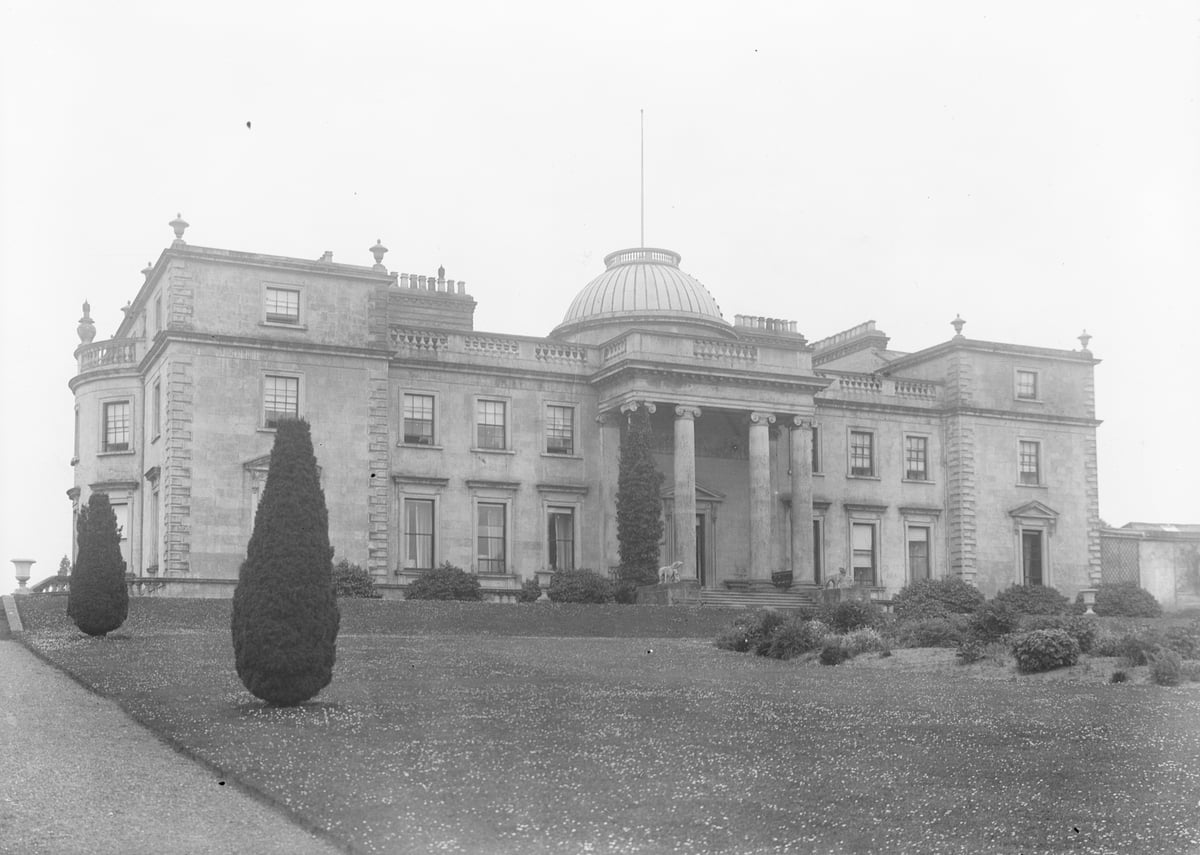
Emo Park, near Portarlington, c.1900–1920. NLI Eason Photographic Collection (Public Domain) via Wikimedia Commons.
Explore Portarlington's past through these archival sources:
- NLI Lawrence Collection — Historic photograph of Main Street, Portarlington
- Historical Picture Archive — Collection of historic Portarlington photographs
- Ordnance Survey 6-inch maps — National Library of Scotland viewer for historic Irish OS maps
- Tailte Éireann map viewer — Modern and historic Ordnance Survey Ireland mapping
Portarlington Today
The 2022 census recorded Portarlington's population at 9,288 — more than doubling since 2002 and making it one of the fastest-growing towns in the Irish Midlands. Sitting just 70 km from Dublin with a rail journey of approximately 45 minutes, the town has become a strong commuter destination.
Each year, an Annual French Festival celebrates the town's Huguenot heritage, drawing visitors to a place where French street names and the old French Church still echo a remarkable chapter in Irish history. The town's architecture — a mix of Georgian and Victorian buildings — reflects the layers of its past, from Huguenot colony to railway junction to modern commuter town.