Dublin Lives
From tenement rooms to suburban homes — the Greene family's journey through 20th century Dublin
Switzers & Co. — A Shop Porter's Life
- 1926 Census: Thomas Greene was recorded as a Shop Porter at Switzers & Co. Drapers.
- Daily route: roughly ten minutes from York Street to Grafton Street.
- Modest wages: a shop porter might earn 25–35 shillings a week in the 1920s.
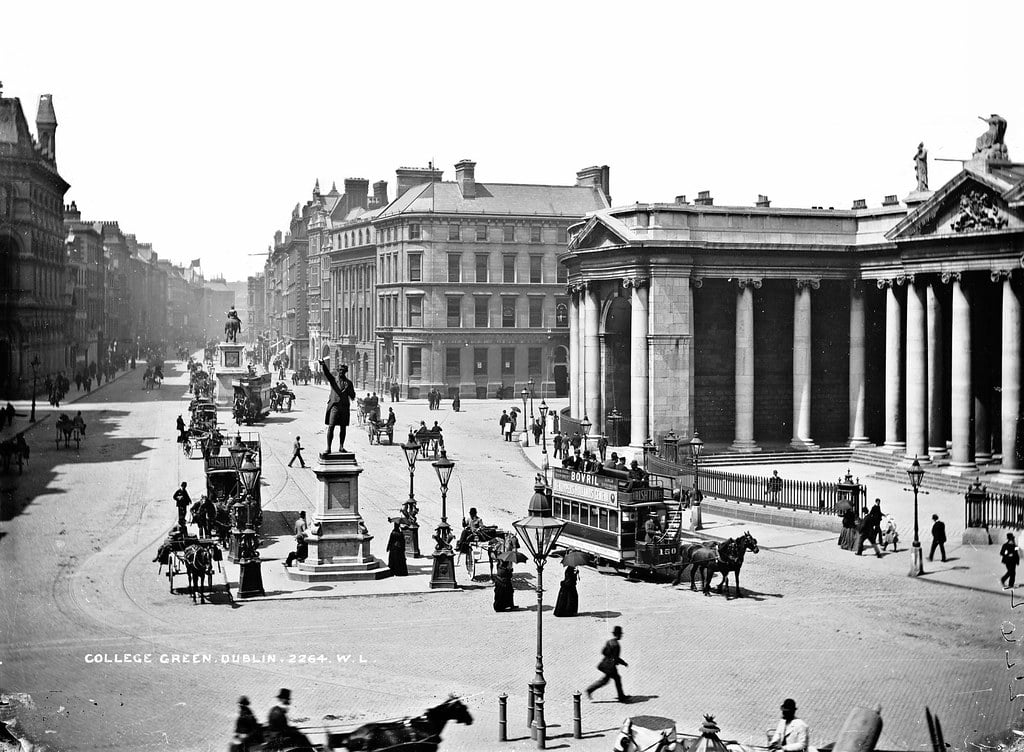
Every morning, Thomas Greene walked the ten minutes from York Street to Grafton Street — past the corners of Aungier Street, across the top of South Great George's Street, and into the beating commercial heart of Dublin.
His destination was Switzers & Co. Drapers, one of the most prestigious department stores in the city, where the 1926 Census records him working as a Shop Porter.
Switzers had been founded in 1838 by John Wright Switzer, a Quaker businessman. By the 1920s, it occupied a commanding presence on Grafton Street — a temple of commerce where Dublin's middle classes and gentry came to buy fabrics, clothing, household goods, and the small luxuries that marked respectability.
The store would endure for over 150 years before becoming Brown Thomas in 1995, the name it carries today.
A Shop Porter was the physical backbone of the retail operation. Thomas would have carried bolts of cloth from the stockroom to the shop floor, moved crates of goods from delivery wagons at the rear entrance, hauled furniture and display fixtures, and kept the arteries of the store flowing.
It was unglamorous, physically demanding work — lifting, carrying, climbing stairs — performed in a starched collar and apron while the well-heeled customers of Grafton Street browsed silks and linens a few feet away.
The wages for such work were modest. A shop porter in the 1920s might earn between 25 and 35 shillings a week — enough to keep a family alive, but not enough to keep them comfortable. There was a strict hierarchy in department stores: the sales assistants who dealt with customers were a class above the porters, messengers, and stockroom hands who kept the operation running from behind the scenes.
Yet working at Switzers carried a certain dignity. It was steady employment in a city where casual labour and unemployment were endemic. Thomas was 55 years old in 1926 — a former soldier, a man who had seen the Boer War — and he had found his place in the rhythms of civilian Dublin.
The walk home to York Street each evening took him from the grandest shopping street in Ireland back into one of the city's most overcrowded neighbourhoods.
York Street — Life in Two Rooms
The 1926 Census paints a picture in numbers that needs no embellishment: five people lived in two rooms. Thomas Greene (55), his wife Bridget (34), their son Patrick (23) — likely from Thomas's first marriage — and two infant boys: John (2) and baby Thomas (9 months). Five lives compressed into two rooms of a subdivided Georgian house on York Street.
York Street ran south from Aungier Street toward St Stephen's Green, placing it squarely in what Dubliners knew as tenement territory. The houses here had been built in the Georgian era for prosperous families — tall, elegant townhouses with high ceilings, ornate plasterwork, and generous proportions. By the early twentieth century, these same houses had been carved into warrens of single-room dwellings, each room home to an entire family.
Dublin's tenements were among the worst slums in Europe. A 1914 government inquiry had found that over 25,000 families in Dublin lived in single-room dwellings — a staggering figure for a city of 300,000. The inquiry described rooms where families of eight or ten slept on straw mattresses on bare floors, where a single privy in the backyard served an entire house of thirty or forty people, and where the stench of decay and sewage permeated every surface.
The Greenes' situation — two rooms for five people — was, by the standards of 1920s Dublin, neither the worst nor the best. They had slightly more space than many, but the reality was still grim. Cooking was done on a small range or open fire. Water came from a shared tap, often in the hallway or yard. The toilet was outside, shared with other families. In winter, the high-ceilinged Georgian rooms were bitterly cold, and damp crept up the walls like a slow tide.
Tuberculosis was the great killer of tenement Dublin. The disease thrived in overcrowded, poorly ventilated rooms, and it cut through working-class families with terrible efficiency. In the 1920s, Dublin had one of the highest TB mortality rates of any European capital. Every family in the tenements knew someone who had been taken by "the consumption."
For Bridget, only 34 and caring for a toddler and an infant in these conditions, life was an unrelenting round of cooking, cleaning, washing, and watching — watching the children for signs of illness, watching the pennies, watching the damp stain on the wall creep a little further each winter. The gap in age between her and Thomas — 21 years — meant she had married a man already weathered by decades of soldiering and labour. Yet they were making a life. Thomas had work at Switzers. The children were alive and baptised. In the tenement world, that counted as holding your ground.
The Corporation Housing Revolution
The Dublin tenements were not merely a disgrace — they were a scandal that successive governments could no longer ignore. Throughout the 1920s and 1930s, Dublin Corporation embarked on one of the most ambitious social housing programmes in European history: the systematic demolition of the inner-city slums and the construction of purpose-built suburban housing estates on the city's outskirts.
The scale of the programme was extraordinary. Thousands of new homes were built in estates across Crumlin, Drimnagh, Kimmage, Cabra, and Inchicore. These were modest houses by any standard — two-storey, red-brick or pebble-dashed terraces — but to families who had lived in single rooms with shared outdoor toilets, they represented a transformation almost beyond imagining.
The Greene family were part of this revolution. At some point in the 1930s, they moved from their two rooms on York Street to 38 Goldenbridge Avenue, Inchicore — one of the new Corporation houses on Dublin's south-western edge.
What did this move mean? It meant a front door that belonged to them alone. A garden — front and back. Separate bedrooms, so that parents and children and young adults were no longer sleeping in the same room. An indoor toilet and running water. A kitchen with space to cook a proper meal. Windows that let in light and air. Walls that were dry.
Inchicore was a neighbourhood with a strong identity. The Inchicore Railway Works — the great engineering and maintenance facility of the Great Southern Railways (later CIÉ) — was the dominant employer, giving the area a distinctly working-class, skilled-labour character. Richmond Barracks, where the leaders of the 1916 Rising had been court-martialled, stood nearby. The Royal Hospital Kilmainham — now the Irish Museum of Modern Art — overlooked the area from its hill. The community was tight-knit, defined by the parish, the local shops, and the rhythm of shift work at the railway.
For Thomas, now in his sixties, the move to Inchicore must have felt like arriving, at last, at something approaching comfort. For Bridget, still raising young children, it meant she could finally keep house in a home that didn't conspire against her at every turn. And for the children — John, Thomas, and the younger ones who would follow, including Brendan and Ita — Goldenbridge Avenue would be the only home they would ever know.
38 Goldenbridge Avenue — A Family Anchor
Some houses are simply addresses. Others become the fixed point around which a family's entire story revolves. 38 Goldenbridge Avenue was one of these — a house that served as the Greene family home for over ninety years, anchoring three generations through the transformations of twentieth-century Ireland.
Thomas Greene died here in 1951, aged around 80. He had lived long enough to see the tenement rooms of York Street exchanged for a proper home, long enough to see his children grow up in bedrooms of their own, long enough to see Ireland become a Republic. The former soldier, the Switzers porter, the man who had walked from York Street to Grafton Street and back every day for years — he ended his days in the house on Goldenbridge Avenue, and it is impossible not to see a kind of hard-won peace in that.
After Thomas's death, Bridget continued at the house as a widow for nearly two decades. She had been 34 when the 1926 Census recorded her on York Street with two babies; she was in her seventies when she died in 1970. The house was hers through all those years — a constancy that the tenement world could never have provided.
And then there was Ita. The youngest of the Greene children, Ita married John Donnelly but never left Goldenbridge Avenue. She lived in the house her entire adult life — through the decades when Ireland changed beyond all recognition, through the Celtic Tiger and its aftermath, through the transformation of Inchicore from a railway community into a sought-after inner suburb. Ita remained at number 38 until her death in December 2025.
Three generations. One address. Over ninety years. In a century that saw two world wars, Irish independence, the destruction of the tenements, the rise and fall of industrial Dublin, the arrival of the modern age — the house at 38 Goldenbridge Avenue stood as the still point in the turning world of the Greene family. It was, in the truest sense, home.
Adelaide Hospital — A Poignant Coincidence
Bridget Greene died at Adelaide Hospital, Peter Street in 1970. She was admitted from Goldenbridge Avenue — the comfortable Corporation home where she had lived for decades. But the hospital where she spent her final days stood on Peter Street, in the very heart of the old Liberties, and barely a few minutes' walk from York Street — the tenement neighbourhood where she had once raised her young family in two rooms.
The coincidence is almost too poignant to bear. A woman who had left the inner city decades earlier, who had raised her children in a proper home with a garden and separate bedrooms, found herself at the end of her life within walking distance of the street where it had all begun — where she had carried water from a shared tap, where she had kept two babies alive in two rooms, where her husband had set out each morning for Switzers on Grafton Street.
The Adelaide Hospital had been founded in 1839 as a Protestant voluntary hospital. By the mid-twentieth century, it served patients of all denominations and was well regarded for its medical care. The Peter Street building was a Victorian institution — all tiled corridors and iron-framed beds — but it provided professional care in a neighbourhood that had seen so much suffering over the centuries.
The hospital closed in 1998, when it merged with the Meath and National Children's hospitals to form the new Tallaght Hospital (now Tallaght University Hospital) on the south-western outskirts of Dublin. The Peter Street building has since been redeveloped. But in 1970, when Bridget lay dying there, York Street was still just around the corner — changed, certainly, but recognisable. The ghosts of the tenements had not yet been entirely exorcised.
The Wider Edwardian City
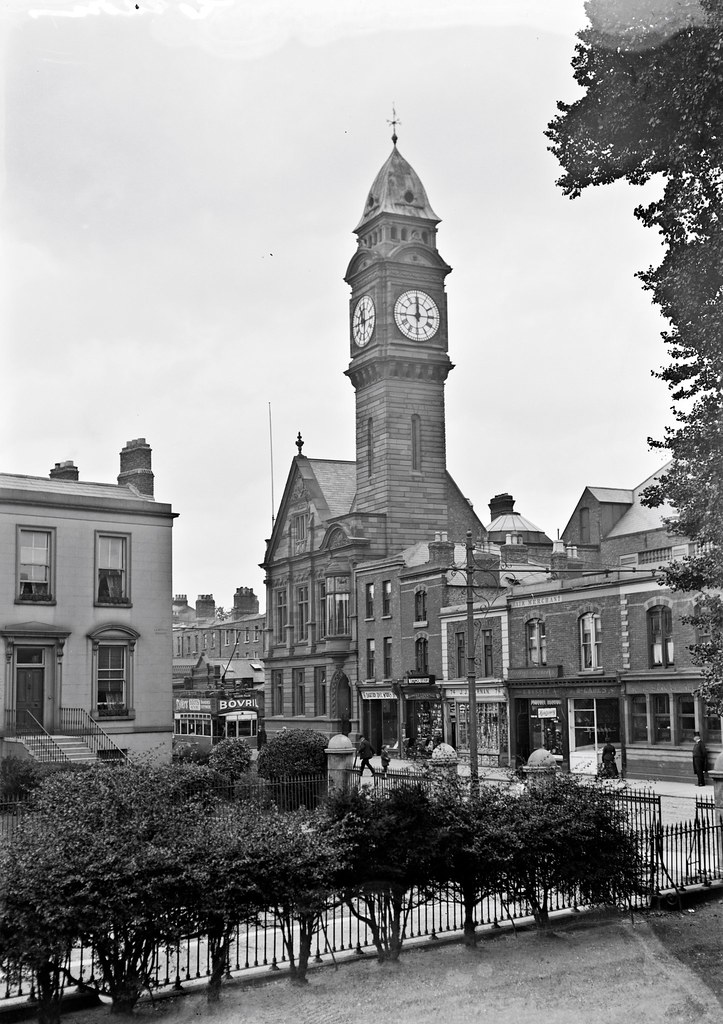
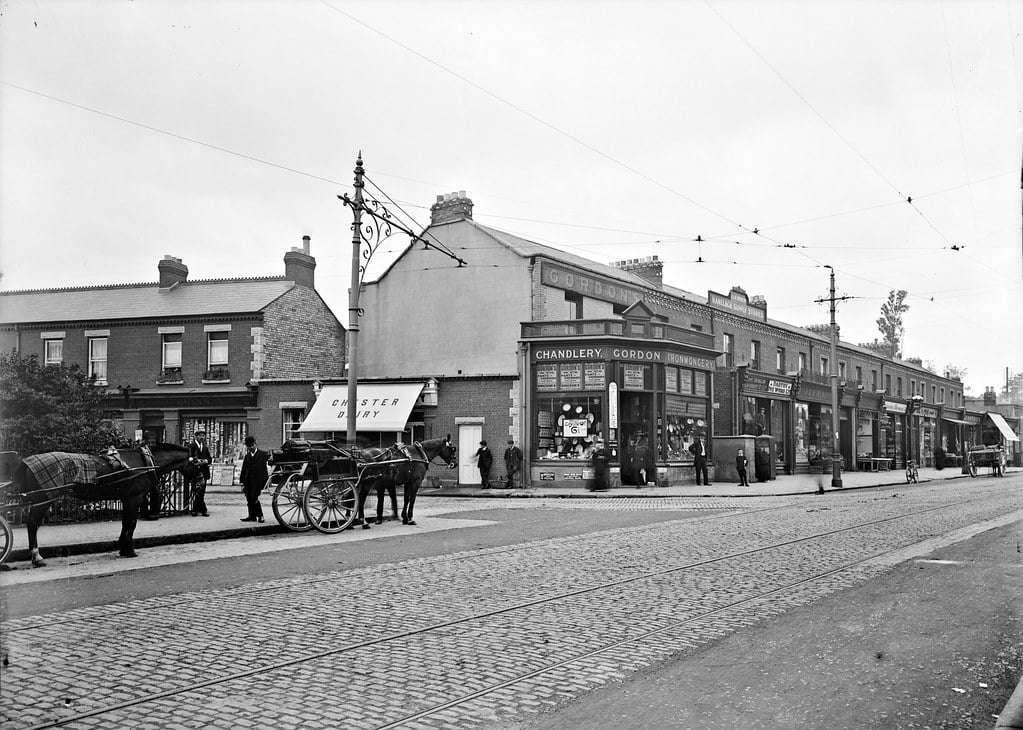
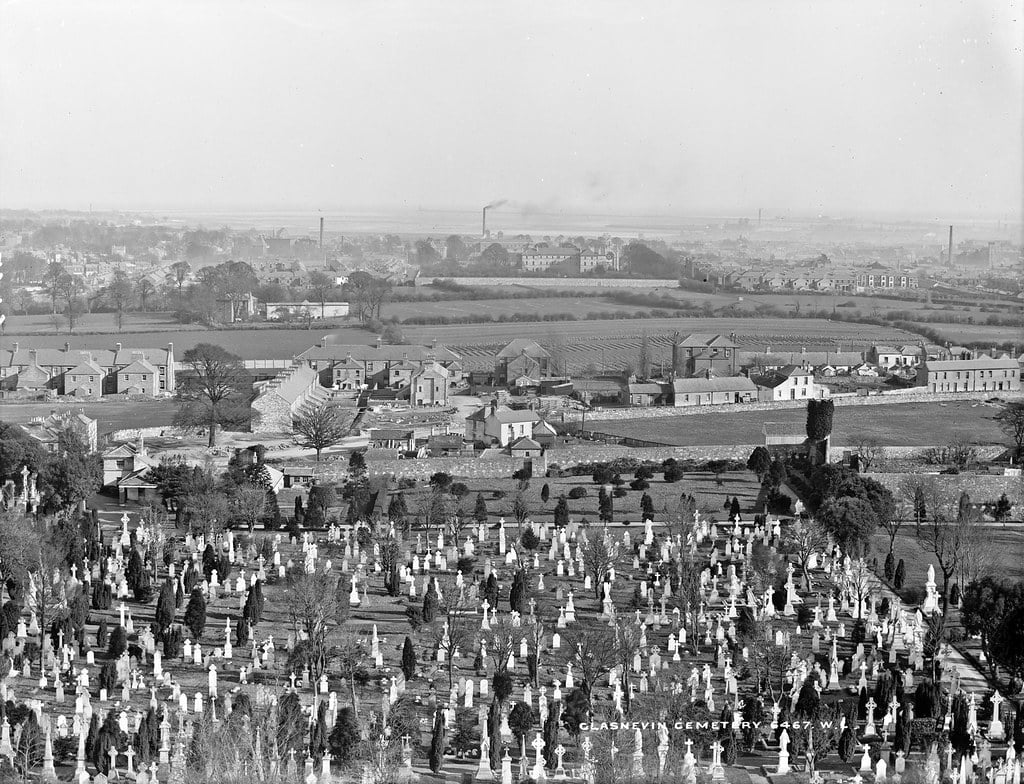
The Greene family's Dublin was not just York Street and Inchicore. It sat inside a wider city of streetcars and shopfronts, of tree-lined suburbs and great Victorian institutions. The Lawrence and Eason photograph collections at the National Library of Ireland preserve much of that wider city as it would have looked when Thomas, Bridget, and their children were making their lives here — a Dublin of horse-drawn trams in Rathmines, of village shop-fronts in Ranelagh, and of the great northside necropolis of Glasnevin where so many Dublin families came finally to rest.
The Next Generation
The story of the Greene children in Dublin is, in miniature, the story of twentieth-century Irish social mobility. From the tenement rooms of York Street to the Corporation house on Goldenbridge Avenue, and then outward again — into the spreading suburbs of south Dublin.
Brendan Greene moved to 62 Limekiln Drive, Terenure — a comfortable, middle-class suburb on Dublin's south side. Terenure, with its tree-lined roads and semi-detached houses, represented a step up from Inchicore. It was the kind of neighbourhood where children attended good schools, where families owned cars, where the front gardens were kept tidy as a matter of pride. Brendan's move from Goldenbridge Avenue to Limekiln Drive traced the arc of upward social mobility that defined so many Dublin families in the post-war decades — from working class to lower middle class in a single generation.
Ita Greene took a different path. She married John Donnelly and stayed at 38 Goldenbridge Avenue — the family home becoming the Donnelly family home, the continuity unbroken. Where Brendan moved outward and upward, Ita held the centre. Both choices were valid expressions of what the Corporation housing revolution had made possible: a stable foundation from which the next generation could either reach further or plant deeper roots.
The family spread across Dublin but never lost its connections. From York Street to Inchicore to Terenure — the geography of the Greene family maps onto the geography of Dublin's social transformation. Each address tells a chapter: poverty, stability, aspiration. And through it all, the thread that connected them was not an address but a family — the Greenes of Dublin, who had started with two rooms and a shop porter's wages, and who had built, generation by generation, something that endured.