Catherine's Story
A widow's struggle in rural Meath, and the daughter who rose from the cottage to a Dublin magistrate's kitchen
Mullaghfin, 1901
- 1901 Census: Catherine Clarke was recorded at House 3, Mullaghfin as a widowed, Roman Catholic general labourer who could not read or write.
- Six children were still in the household, from Rose (23) down to Agnes (5).
- Mullaghfin was rural, labouring Meath — far from Dublin's growing commerce.
The census enumerator came to House Number 3 in the townland of Mullaghfin sometime in the spring of 1901. He recorded what he found in the careful bureaucratic hand that would, more than a century later, be the only surviving portrait of this family.
Catherine Clarke was age 40, widowed, and head of household. Religion: Roman Catholic. Occupation: General Labourer. Literacy: cannot read, cannot write.
She had six children. Rose, the eldest, was 23 — already a grown woman, but still at home. Patrick was 18, old enough to work. Then came the younger ones: Mary at 12, Jane at 10, Bridget at 9, and little Agnes, just 5 years old.
Six mouths to feed. One pair of hands to do the earning — or rather, three pairs if Rose and Patrick brought in wages, but the arithmetic of survival in rural Meath at the turn of the twentieth century was brutal and unforgiving.
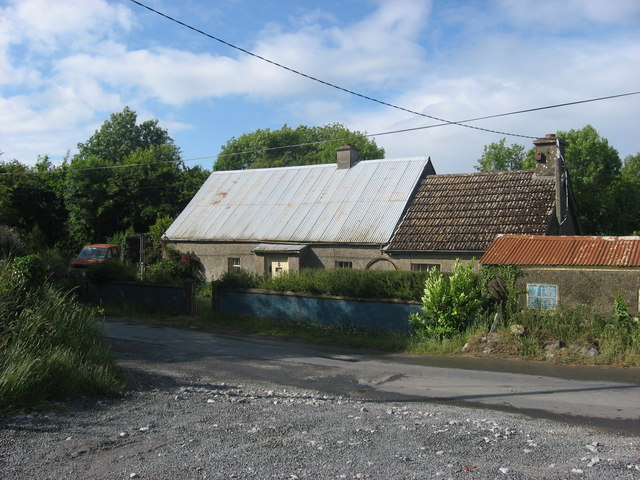
Mullaghfin is a townland of about 256 acres in the civil parish of Duleek, barony of Duleek Lower, County Meath — roughly 30 miles north of Dublin and 5 miles inland from the coast at Bettystown. It sits in a landscape of low rolling pastureland, bordered by the townlands of Balrath, Garballagh, Gaskinstown, Sicily, and Thomastown.
The village of Duleek itself — one of the earliest Christian sites in Ireland, founded by St Patrick's disciple St Cianán in the 5th century — lies a short walk to the east. Meath was the Royal County, seat of the ancient High Kings at Tara, with some of the richest farmland in Ireland.
But that land belonged to others. In 1901, Mullaghfin was a place of scattered labourers' cottages and small holdings, far from the growing commerce of Dublin. For a widowed woman with no property, no education, and no trade beyond the strength of her own body, Mullaghfin offered subsistence at best and destitution at worst.
"General Labourer" — the census enumerator's term — meant whatever work was available and whatever a woman could be hired to do. Thinning turnips. Picking stones from ploughed fields. Hay-making in summer. Road-mending for the county council. Washing. Carrying. The kind of work that broke bodies and paid almost nothing. In late-Victorian Ireland, a female labourer might earn sixpence a day — half what a man would receive for the same work.
A Widow's Burden
Catherine's husband — Patrick Clarke, a labourer of Mullaghfin — died sometime between December 1891 and the 1901 Census. We know he was alive on the 26th of December 1891 because his name appears on his daughter Bridget's birth register, signed off in his still-living capacity as the father at Mullaghfin.
By 1901 he was gone. His exact death date and cause are not yet documented — disease, accident, or simple exhaustion could each have carried off a labouring man in 1890s Ireland.
What we know is what he left behind: Catherine — who could not read or write — and six children, the youngest just five years old. (Patrick's identity, and Catherine's maiden name Clinton, were both confirmed in April 2026 from the civil birth register of their daughter Bridget. See "What We Now Know" below.)
To understand Catherine's position, you must understand what widowhood meant for a woman of her class in rural Ireland. There was no widow's pension — that would not come until 1935. There was no social welfare system beyond the workhouse, and the workhouse was a place of last resort and deep shame. The Poor Law system, inherited from the Famine era, offered outdoor relief in some cases, but it was meagre, means-tested, and administered by guardians who often viewed poverty as a moral failing.
Catherine had no land. The census does not record her as a farmer or a farmer's wife — she was a labourer, which meant she worked on other people's land. Without property, she had no collateral, no inheritance to pass on, no stake in the rural economy beyond her labour. She was, in the language of the time, a cottier — someone who lived in a labourer's cottage, often tied to an estate or farm, paying rent in work rather than money.
The eldest children would have been essential. Rose, at 23, was likely working as a domestic servant or farm labourer herself. Patrick, at 18, would have been old enough for farm work or seasonal labour. Together they might have kept the family just above the waterline. But the four younger children — Mary, Jane, Bridget, and Agnes — could not yet earn, and they all needed feeding, clothing, and whatever shelter House Number 3 provided against the Meath winters.
A House That Empties
What the 1901 Census shows us, with its careful enumeration of seven Clarkes at House Number 3 Mullaghfin, is a house that is full. By the 1911 Census, ten years later, Catherine Clarke is alone. Every one of her six children — Rose, Patrick, Mary, Jane, Bridget, Agnes — has gone.
We can follow only one of them with certainty: Bridget, the second-youngest, the one whose granddaughter Ita would one day be Mark Garrigan's grandmother-in-law. The trail of her departure runs from Mullaghfin to Dublin — about thirty miles south as the crow flies, a world away in every other dimension.
In 1901 Bridget was nine years old. The census records her at home with her mother and siblings and notes her occupation as Scholar — a child still in school. She was learning to read and write. Whatever else Catherine could not provide, she ensured her daughter was sent to be educated. That literacy would, in time, carry Bridget out of Mullaghfin entirely.
Sometime in her teens — we cannot yet say precisely when — Bridget made the journey to Dublin and entered domestic service. Thousands of young Irish women of her generation made the same journey: it was, for the daughters of widows and labourers, the most reliable route out of the rural poverty into which they had been born. The remarkable thing is not that Bridget went, but how high she had climbed by the time we find her again.
April 1911 — Cook in a Magistrate's House
On Sunday 2 April 1911 the census enumerator Robert J. Holmes called at the Dublin home of Joseph Dollard, Justice of the Peace and Printer-Master, and recorded the eight people who had slept under that roof the night before. Joseph (40) was head of the family, married to Sarah (34); they had three young daughters at home — Mary (14), Kathleen (13) and a baby, also Sarah, just three months old. To run a household of that size and respectability required servants. Three of them appear on the form.
First, a Nursery Governess: Ellen Clancy, 24, also from County Meath. Then, on the seventh line of Form A, in the careful hand of the head of household: Bridget Clarke. Servant. Roman Catholic. Read & Write. Age 19. Cook — Domestic. Single. Co. Meath. And below her, the Housemaid: Margaret Brien, 20, from County Wexford.
A nineteen-year-old cook is not an ordinary servant. The hierarchy of Edwardian domestic service was rigid and well understood — and Cook was an upper-tier role, second only in many households to the housekeeper. The cook ran the kitchen. She planned meals, ordered provisions, managed the housemaid in matters of the table, kept account of the stores, and answered to the mistress of the house. To hold that position at nineteen, Bridget must have served an apprenticeship somewhere — a kitchen-maid in another household first, learning her craft well enough to be trusted with a magistrate's table.
Joseph Dollard was almost certainly part of the Dublin printing dynasty: Dollard's Printing House Ltd on Wellington Quay had been a fixture of the city's commercial life since the mid-nineteenth century, printing everything from theatre programmes and railway timetables to ecclesiastical texts. As a JP — a Justice of the Peace, a magistrate — Joseph was also a man of the city's professional class, sitting on the bench, dispensing summary justice. The house on whose Form A Bridget appeared was respectable, busy, and a long way from a labourer's cottage in Mullaghfin.
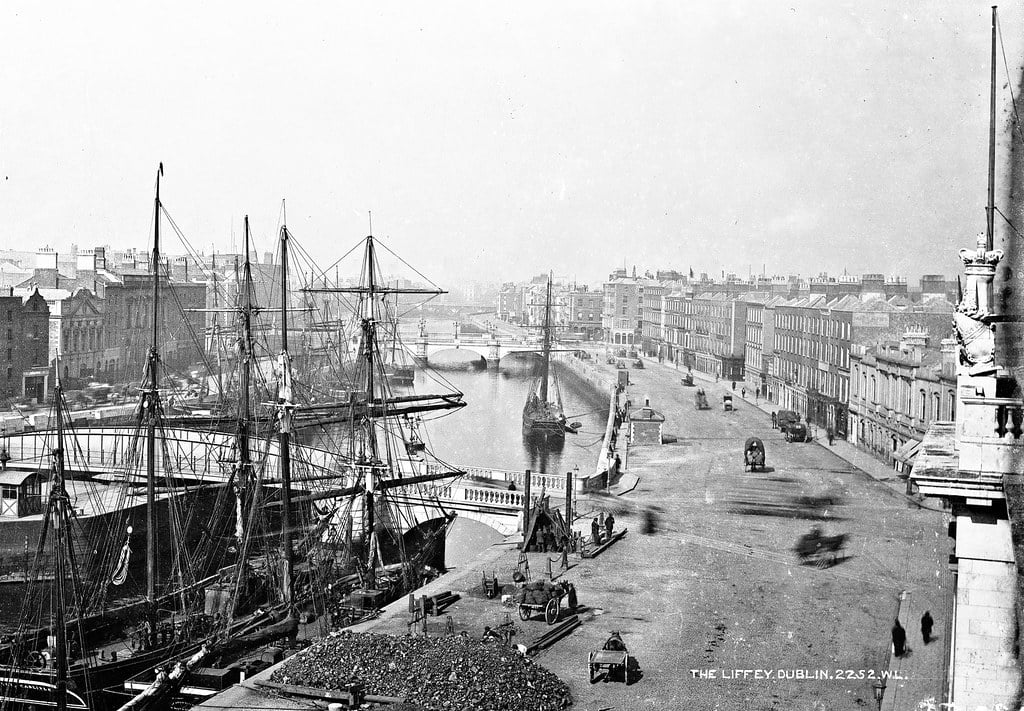
Family memory, transmitted down through three generations to her granddaughter Ita, preserved this fact about Bridget: that she had been a cook in service in Dublin before she married Thomas Greene. For a long time we had only the oral history. The 1911 Form A — discovered in April 2026 — is the documentary proof. It tells us not only that the family memory was true, but that Bridget had reached that station by the age of nineteen.
She was the daughter of an illiterate widow who could not sign her own name. Ten years before, she had been a nine-year-old in a labourer's cottage in Meath. Now, at nineteen, she was running the kitchen in a JP's Dublin household. There is a quiet, formidable will in that arc that the census forms can only hint at.
From Meath to Dublin
The arc of Bridget Clarke's life, traced through the census records and civil registers, describes a trajectory that was shared by thousands of Irish women of her generation — a journey from rural poverty through domestic service to urban married life in a single generation.
2 December 1891: Born in Mullaghfin, County Meath, to Patrick Clarke (labourer) and Catherine née Clinton. The fifth of six children in a labourer's cottage. Birth registered at Duleek on 26 December 1891 by registrar James Kelly; informant Julia Boylan, who was present at the birth and signed with her mark.
1901 (age 9): Living at home in Mullaghfin with her widowed mother and siblings. Recorded as a Scholar — in school — while her mother works as a General Labourer and cannot read.
1911 (age 19): In Dublin, working as Cook in the household of Joseph Dollard, Justice of the Peace and Printer-Master. Already in the senior kitchen role of a respectable city household. She has crossed both miles and worlds — from a cottage in Meath to the kitchens of Edwardian Dublin — and she is literate where her mother never could be.
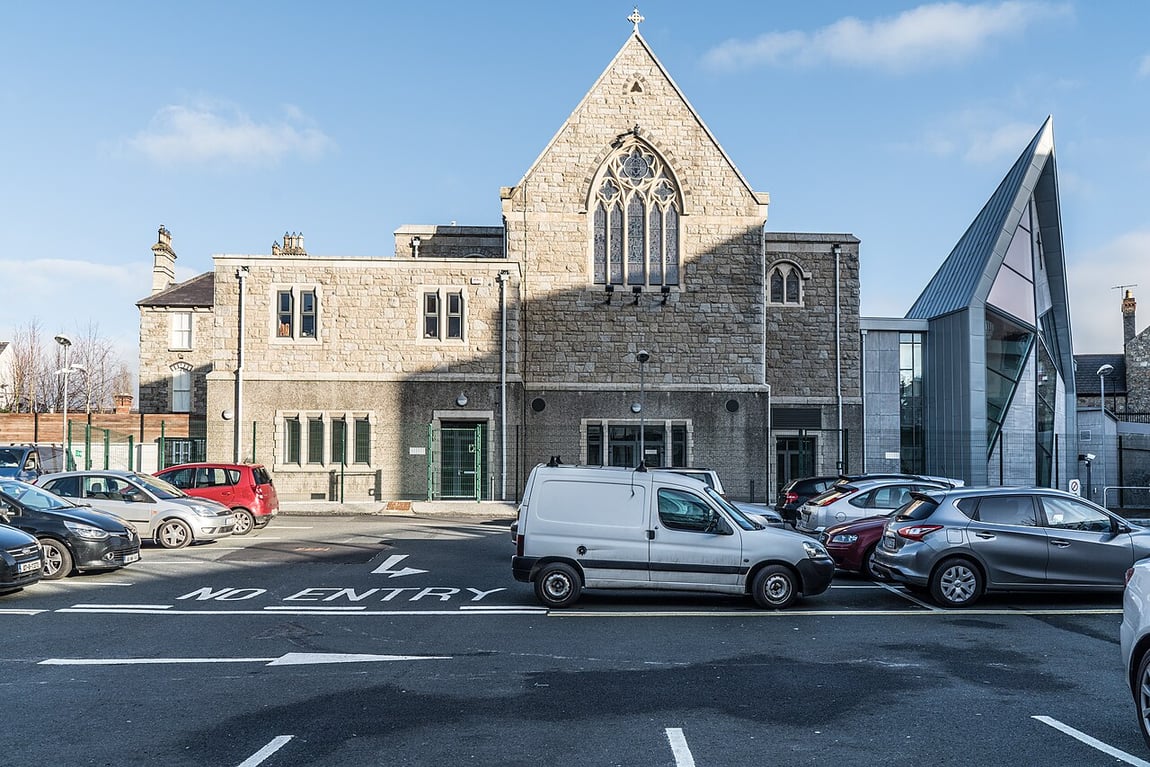
20 June 1922: Married Thomas Greene at the Roman Catholic Church of Holy Cross, Dundrum (Rathdown Registration District, Co. Dublin). Bridget was working as housekeeper at Drummartin House, Dundrum; Thomas was a widower, working as a warehouseman in the city. Witnesses: Patrick Kennedy and Annie O'Malley. The marriage register names Bridget's father as Patrick Clarke (Farmer) and Thomas's father as William Greene (Traveller).
1926: By the time of the first census of the Irish Free State, Bridget is a wife and mother of three, living at York Street, Dublin — one of the city's dense inner-city streets, a place of tenements and trade, of families packed into Georgian houses that had seen grander days.
Consider what this journey meant. In the space of thirty-five years, Bridget went from being the daughter of a widowed labourer in a Meath townland to being a literate, married, urban mother in the capital of a new nation. She learned to read and write — something her mother never could. She rose to Cook in a magistrate's house. She escaped the trap of rural poverty that had defined her childhood. She built a family.
But the cost of that journey was separation. By 1911, all six of Catherine's children had left Mullaghfin, and as far as the surviving records show, none returned in any sustained way. Domestic servants had little freedom and less money to travel. By the time Bridget was established in Dublin, her mother was an ageing charwoman in a house that had emptied of children, one by one.
Catherine Survives
The 1911 Census finds Catherine Clarke still at Mullaghfin, still at House 3, still in the Duleek District Electoral Division. She is now 55 years old. Still widowed. Her occupation has changed — she is now listed as a Charwoman, which meant she cleaned other people's houses for pay. She still cannot read. She still cannot write.
And she is alone.
Every one of her six children has gone. Rose, Patrick, Mary, Jane, Bridget, Agnes — all of them have left Mullaghfin, scattered to Dublin, to service, to marriages, to lives that the census records of other townlands and other counties might one day reveal. Catherine remains. The house that once held seven people now holds one.
There is something almost unbearable in the simplicity of this record. A woman who was widowed young, who raised six children alone, who worked as a labourer and then as a charwoman, who could never read a letter or sign her own name — and who, after all of it, was still standing. Still at Mullaghfin. Still in the same house. Still alive.
In the Ireland of 1911, a 55-year-old charwoman was old. Life expectancy for women of her class hovered around 50. She had outlived her husband by at least fifteen years. She had survived the grinding poverty of the 1890s, the economic stagnation of the early 1900s, and the slow haemorrhage of emigration and domestic service that drained rural Ireland of its young. She had endured.
We do not know when Catherine died, or where she is buried. There is no gravestone that we have found, no death certificate yet located. She left no letters — she could not have written them. She left no photographs that we know of. What she left were her children, and through them, the family that would eventually include the Greenes of York Street, Dublin, and all who came after.
What We Now Know — and What Remains
Family history is as much about absence as presence — about the questions that the records do not answer, the silences between the census lines. In April 2026 two of the deepest silences around Catherine's life were finally broken.
Catherine's husband had a name: Patrick Clarke. He was a labourer of Mullaghfin. He was alive on 26 December 1891 — the day his daughter Bridget's birth was registered at Duleek — and dead by the 1901 Census. We learned this from the original civil birth register for Bridget (Duleek RD entry 107), recovered in April 2026. The same record gave us Catherine's maiden name: Clinton. After thirty years of being only "the widow" on the census forms, she has, at last, her own name back: Catherine Clinton, who married Patrick Clarke in Co. Meath in the 1870s.
An earlier search had thrown up a tempting lead — a marriage of "Patrick Clarke × Catherine McKenna" in Navan in 1875 — and for a few hours it looked as if we had Catherine's parents too. The 1891 birth register settled the matter: Catherine's maiden name was Clinton, not McKenna; the Navan couple were a different family. The corrected search (Patrick Clarke × Catherine Clinton, Co. Meath 1880–1893, then nationally 1875–1895) returned no civil-register hits at all — even with the year window widened and the search run symmetrically from the bride's side. The marriage is therefore most likely a Catholic church marriage that was not civilly registered (very common in rural Ireland in the early years after 1864), or it occurred before 1875. The next step is the National Library of Ireland's RC parish registers for Duleek / Bellewstown (Diocese of Meath).
Bridget's marriage to Thomas Greene was not a vague "early 1920s" affair — it was 20 June 1922, at the Roman Catholic Church of Holy Cross, Dundrum, in the new Irish Free State barely six months old. Bridget was housekeeper at Drummartin House, Dundrum; Thomas had given his address in Dublin city. The marriage register also gave us Thomas's father — William Greene, a "Traveller" (almost certainly a commercial traveller / travelling salesman) — and so a piece of the Greene family in Portarlington fell into place at the same time.
What we still do not know:
- When and how Patrick Clarke died. Sometime between December 1891 and the 1901 Census, but the death register for Drogheda RD has not yet been searched.
- Catherine's death. Last seen alive in the 1911 Census, age 55, at the same House 3 Mullaghfin. The death register for Drogheda RD c.1911–1930 should record her end.
- Catherine's parents — the Clintons. Her own birth/baptism record (Co. Meath, c.1861) would name them.
- How often Catherine saw Bridget after she went into service in Dublin. Thirty miles by road, a few hours by train — but a train fare was beyond a labourer's means, and a working domestic servant had little freedom to travel. Did Bridget write home? She had learned to read and write — but her mother could not have read a letter. Did someone read it to her? Or was the separation, in practice, near-total — the way poverty made so many quiet, irrevocable separations in families across Ireland?
- If Bridget ever returned to Mullaghfin. By 1911 she was in Dublin, and by the 1920s she was married with children of her own. Did she ever take the train north to Meath, walk the lane to House 3, and knock on her mother's door? Or did the distance — geographical, social, emotional — prove too great?
Other records that might fill the gaps:
- Duleek parish registers — baptisms, marriages, and burials for the Mullaghfin area, held by the Catholic parish of Duleek or the National Library of Ireland microfilm collection
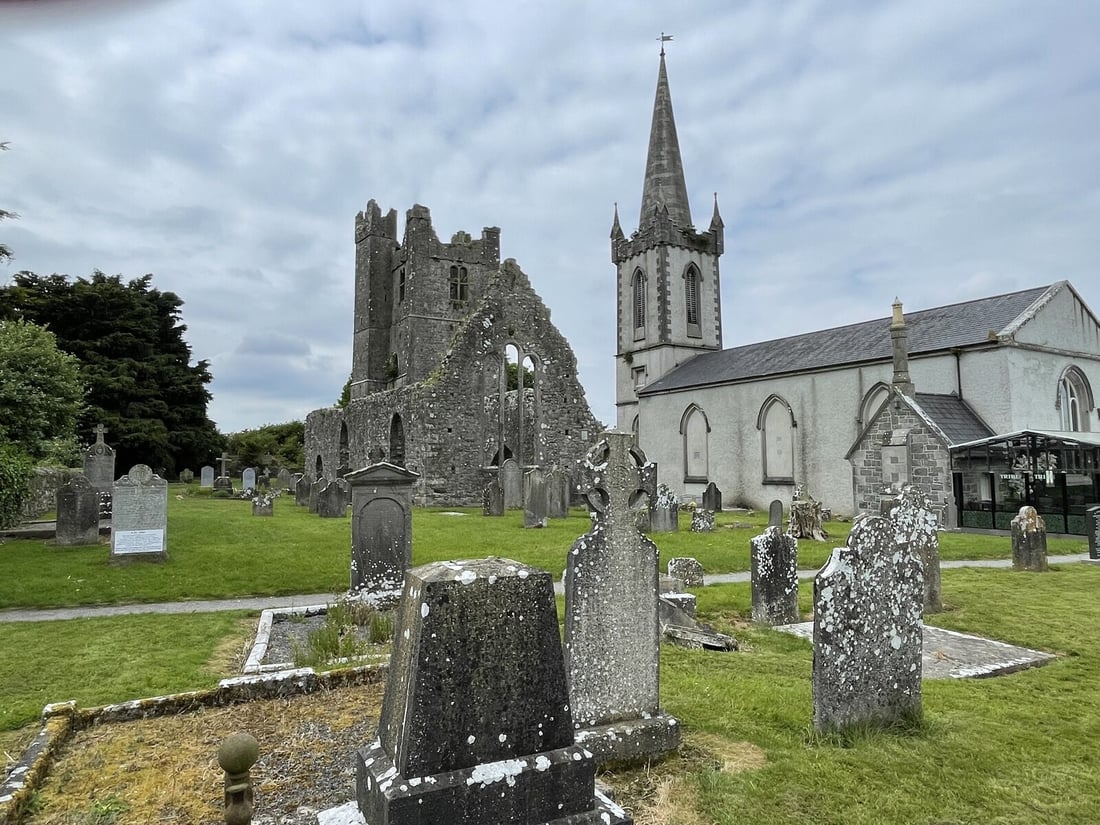
- Duleek Old Churchyard gravestone — a transcription published by the Meath History Hub records: "Erected by the children of Thomas and Bridget Clarke of Duleek in loving memory of their father who died 23 January 1877 aged 45 years and their mother who died 25th January 1882 aged 44 years. Also their brothers, Patrick (d.1897, age 28) and Richard (d.1937, age 72)." Now that we know Catherine's husband was Patrick Clarke (alive in 1891), the brother Patrick on the gravestone (b.~1869) is too young to be him. But the dates and naming pattern still strongly suggest Thomas Clarke (d.1877) and Bridget Clarke (d.1882) of Duleek were Patrick Clarke Snr's parents — i.e. Bridget Greene's paternal grandparents. The granddaughter Bridget (b.1891) was named for the grandmother Bridget. Awaiting confirmation via Patrick Clarke Snr's baptismal record.
- Poor Law Union records for Drogheda Union (which covered Duleek) — outdoor relief lists, boarding-out registers, and workhouse admission records
- Dollard family / Dollard's Printing House records — household accounts or business papers from Joseph Dollard's Dublin household and the Wellington Quay printing firm, which might record Bridget's hiring and the terms of her employment as Cook
- Griffith's Valuation revisions for Mullaghfin — to establish who owned the land and cottage where Catherine lived
- Civil death registers for Duleek registration district — to find Catherine's death and, through it, her husband's name
- 1926 Census (when released by the Central Statistics Office) — which may show Catherine if she was still alive, or confirm her children's locations
Catherine Clarke's story is incomplete. But incomplete is not the same as lost. Every record we find draws the picture a little clearer — a woman who lived in hardship, who sent her children into the world because she had no other choice, and who endured alone in a house that had once been full. She is the root of a family that would grow in Dublin and beyond, and her story deserves to be told — even with its silences, even with its gaps, even with all the things we do not yet know.