Thomas's Military Service
The Leinster Regiment and the Boer War
Why Young Men Enlisted
Rural Ireland in the 1880s offered few opportunities for young men like Thomas Greene. Farm labourers earned pittance wages, and the long shadow of the Great Famine still lingered over the midlands — shaping expectations, limiting horizons, and driving emigration.
The British Army offered a way out. A private soldier earned roughly 1 shilling per day — about £18 per year. It was modest, but it was guaranteed, and it came with food, clothing, and accommodation. For a young man from Portarlington with no land and no trade, that certainty was worth a great deal.
Thomas didn't wait for the official enlistment age. According to family history, he lied about his age and joined the army at around fourteen — roughly 1885. This was remarkably common in the late Victorian army. Recruiting sergeants, under pressure to fill their quotas, often turned a blind eye to obviously underage boys. Some recruits were as young as twelve. For a boy in Portarlington with few prospects, the army's promise of regular meals, a uniform, and adventure was irresistible.
The army also promised something money couldn't buy: travel. Regiments rotated through postings in India, Canada, the West Indies, and South Africa. A boy who had never left King's County could see the world.
Many midlands families had generations of military service behind them. In the towns around Birr and Portarlington, soldiering was a respectable profession regardless of religion — Catholic and Protestant men served side by side.
The Prince of Wales's Leinster Regiment
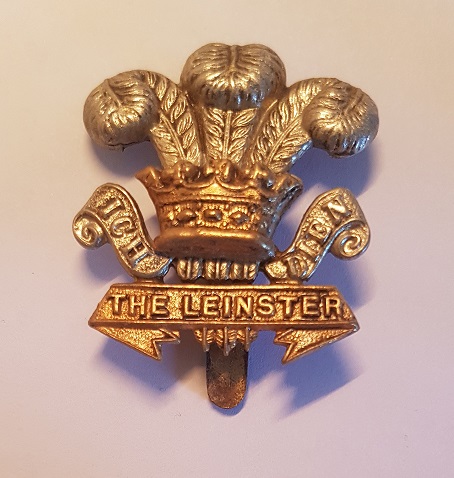
The Prince of Wales's Leinster Regiment (Royal Canadians) was formed in 1881 as part of the Childers Reforms, which linked infantry regiments to specific recruiting districts. The Leinsters were headquartered at Crinkill Barracks, Birr, King's County (Offaly) — only about 25 miles from Portarlington.
The regiment recruited primarily from the midlands counties: Meath, Westmeath, Longford, King's County, and Queen's County (now Laois). For Thomas Greene, it would have been the natural regiment to join.
The regimental motto was "Ich Dien" (I Serve), inherited from the Prince of Wales's crest. The quick marches were "The Royal Canadian" and "Come Back to Erin" — a nod to both the regiment's Canadian battle honours and its Irish heart.
A full regimental history was published in 1924 by Lt-Col F.E. Whitton and is freely available on the Internet Archive.
The Second Boer War (1899–1902)
When war broke out in South Africa in October 1899, the Leinsters' 1st Battalion was called to serve. They arrived at the Cape around May 1900 and were assigned to the 16th Brigade, VIIIth Division, under the command of General Rundle.
May–July 1900: The battalion was stationed at Hammonia on extremely low rations. The VIIIth Division was the only division without Army Service Corps support, meaning supplies were erratic at best. Men went hungry while Boer farms in the surrounding countryside had ample provisions — a bitter irony not lost on the soldiers.
September 1900: The battalion formed part of a column based on Harrismith, sweeping the eastern Orange River Colony.
October 1901: The Leinsters garrisoned Vrede and manned the chain of blockhouses in the Brandwater Basin — the lonely, dangerous work of holding the line against Boer guerrillas.
A Guards officer who visited them wrote: "The Leinsters garrison the blockhouses; they are splendid fellows; just as Irish as they can be, and work like slaves."
April 1902: Heavy fighting at Bethlehem — 14 men wounded. The war was entering its final, grinding phase.
When peace came in June 1902, 370 men of the battalion departed South Africa on the SS Englishman in late September 1902, heading home to Ireland.
Life of a Soldier
A soldier's daily reality in South Africa was far from glamorous. Pay was roughly 1 shilling per day, subject to deductions for kit replacement and other stoppages that could leave a man with very little in his pocket.
Rations consisted of hardtack biscuits, bully beef (tinned corned beef), tea, and the occasional tot of rum. Fresh food was rare, especially on the veldt.
The greatest killer was not Boer marksmanship but disease. Over 8,000 British soldiers died of typhoid and other illnesses during the war, compared to roughly 7,000 killed in combat. Sanitation was poor, water sources were often contaminated, and medical care was stretched thin.
Despite these hardships, the Leinsters were consistently noted for their cheerfulness and resourcefulness — qualities that would serve them through far worse in the years to come.
The Forgotten Soldiers
The regiment earned the battle honour "South Africa 1900–02" for its service in the Boer War.
When the Great War came in 1914, the Leinsters served with extraordinary distinction — at Ypres, the Somme, Gallipoli, and Salonika — earning four Victoria Crosses.
But the regiment did not survive Irish independence. The Leinsters were disbanded on 31 July 1922 under the terms of the Irish Free State agreement. Their Colours were laid up at Windsor Castle — far from the midlands parishes that had filled their ranks for forty years.
In the new Ireland, veterans of the British Army faced hostility and suspicion. Men who had fought at Gallipoli and the Somme found their service deliberately forgotten — or worse, treated as a source of shame. For decades, their sacrifices went unacknowledged.
It was not until 2013 that a memorial to the Leinster Regiment was erected in Birr by the Regimental Association — a long-overdue recognition of the men who served.
Further Research
- Medal rolls at the UK National Archives — WO100 series — may contain Thomas Greene's name and service details
- Whitton's regimental history (Vol. 1): Read on Internet Archive
- National Army Museum — Leinster Regiment: NAM Collection
- Anglo-Boer War unit records: angloboerwar.com — Leinster Regiment